
Our sand scoured, sea sprayed, wave washed, wind played islands
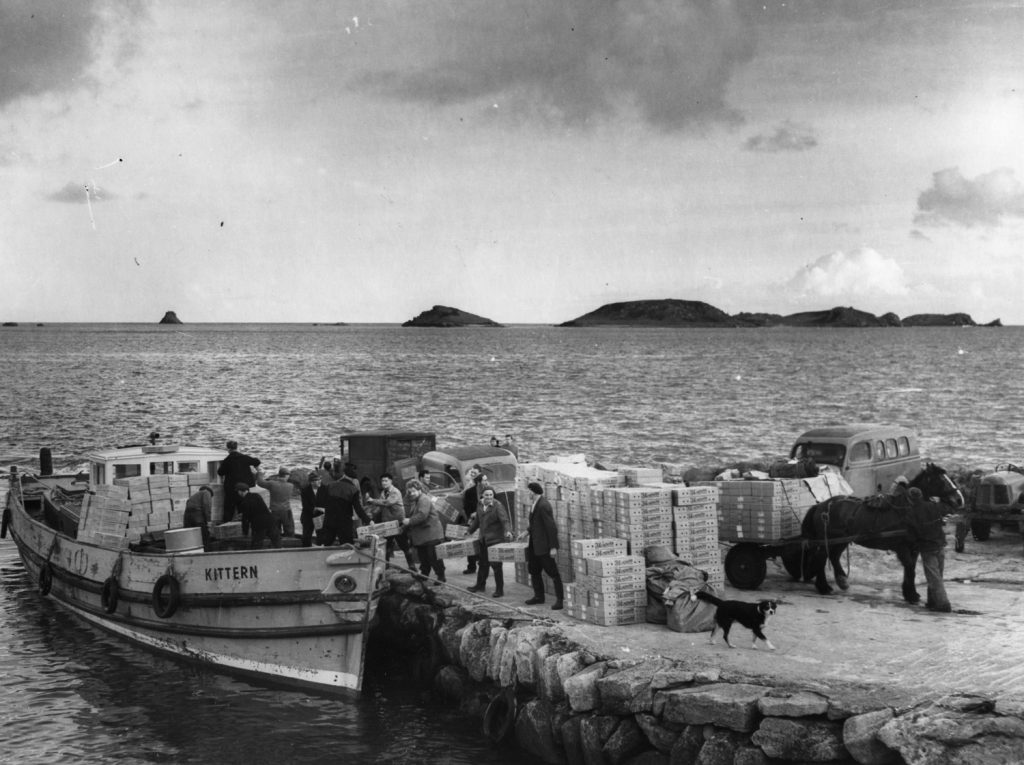
Life on the Isles of Scilly has always depended on boats – connecting us to the wider world, for fishing, trade and inter-island travel.
Today boats bring food deliveries, tourists and islanders depend on inter-island boating, and off-island school children travel a weekly commute to board on St Mary’s from the age of 11.
7000 years of Scillonian sailors
People have lived on these islands for 7000 years, arriving on boats made of wood and animal skins in the Mesolithic (middle stone age). Our collection includes early axes brought here from Cornish green stone at the end of neolithic/early bronze age. In those early times the islands were all one land mass, Ennor, with St Agnes the first to separate.
A graveyard of shipping
Our perilous waters are a graveyard of more than 700 wrecks and our Museum collection is filled with heroic tales of lifesaving by Scillionian gigs rowing to the rescue. From the 16th to the 18th century the islands were used by pirates and smugglers, and the seabeds hold sunken treasures from The Colossus, The Association Disaster and more recently The Cita. The islands’ importance to shipping, and the number of wrecks, grew through the centuries. The coal fired lighthouse on St Agnes was only the second in the UK 1680 and local merchant Thomas Ekins built Daymark St Martins 1683. New lighthouses were built at Bishop Rock in 1857 Round Island in 1857 Penninis in 1911.

Excrescences of the island? Daniel De Foe
“I have ended this account at the utmost extent of the island of Great Britain west, without visiting those excrescences of the island, as I think I may call them, (viz.) the rocks of Scilly, of which, what is most famous, is their infamy, or reproach; Namely, how many good ships are, almost continually dash’d in pieces there, and how many brave lives lost, in spight of the mariners best skill, or the light-houses, and other sea-marks best notice.”
– Daniel Defoe, “Appendix to Letter III,” A Tour thro’ the Whole Island of Great Britain Vol.1, (1724-7).315
Scilly’s Master Mariners
By the mid 19th century around 20 speedy 45-65 foot Scillonian pilot cutters roamed the Western approaches- each with a crew of eight pilots plus a ‘man and boy’ to sail home. Compulsory education, introduced here in the 1840s, focussed on navigation and Scillonian education produced135 certified master mariners.
But pilotage by gig or pilot cutter dropped away towards the end of the nineteenth century, and attempts to create a commercial pilchard fishing fleet were abandoned.
Now we have more tripper boats than fishing boats but the sea remains at the heart of life on the islands. Our first RNLI lifeboat arrived in 1874 and the current lifeboat has a crew of seven and 12 minute launch time – islanders still put out in the roughest of weather to save lives.
